

-
1 Steuerruder
* * *das Steuerruderrudder; helm* * *Steu|er|ru|derntrudder* * *das1) (the wheel or handle by which a ship is steered: He asked me to take the helm (= steer the ship).) helm2) (a flat piece of wood, metal etc fixed to the back of a boat for steering.) rudder* * *Steu·er·ru·dernt rudder* * ** * *n.helm n. -
2 Heckruder
n < aerospace> ■ tail control surface -
3 Hilfsruder
n < aerospace> ■ servo-control surface; servo-tab; tab -
4 Rudermaschine
-
5 Steuer
-
6 Steuerfläche
f < aerospace> ■ control surface -
7 Leitfläche
f[an Flugkörper, Flugzeug]control surface -
8 Rudermaschine
f1. control-surface actuator2. rowing machine [gym equipment] -
9 Steuerfläche
f[an Flugkörper, Flugzeug]control surface -
10 SCS
stop control system — антиблокировочная система, АБСspeed-connection system — система ускоренного развёртывания автокранового комплекса из транспортного положения в рабочее -
11 Oberamtmann
Oberamtmann
bailiff;
• Oberaufseher chief inspector, superintendent;
• Oberaufsicht superintendence, inspectorship, supervisory control, supervision;
• Oberbau (Bahn) permanent way, roadbed, (Brücke) superstructure, (Straße) surface;
• Oberbegriff (Patentschrift) preamble;
• Oberbergamt Board of Mines;
• Oberbuchhalter chief (senior) accountant;
• ehrenamtlicher Oberbürgermeister Lord Mayor (Br.);
• Oberdurchschnitt average of averages;
• Oberfinanzdirektion Regional Office (US);
• Oberfinanzpräsident [etwa] Chief Inspector of Taxes (Br.);
• Oberfläche surface;
• Oberflächenbeschaffenheit (Papier) finish;
• Oberflächengewässer von organischer Verschmutzung reinigen to clean up all surface and coastal waters of organic pollution;
• Oberflächenschaden surface damage. -
12 Tafel
f; -, -n1. (Schultafel) (weiße) (white-) board; (für Kreide) (black)board, Am. auch chalkboard; (Schiefertafel) slate; hist. (Schreibtafel) tablet; an die Tafel schreiben write (up) on the (black- altm.) board; die Tafel putzen clean the board, wipe the board clean; komm mal vor an die Tafel! come up (here) to the board!2. (Anschlagbrett) notice (Am. bulletin) board; mit Grafiken: display board; (Schild) notice, sign(board); (Platte, auch Bildtafel) plate; aus Stein: slab, tablet; aus Holz: panel, board; (Gedenktafel) plaque; (Blech) sheet, plate; eine Tafel mit den Wanderwegen etc. a board ( oder notice) showing the trails etc.3. (Schalttafel) control panel, console, switchboard4. (Tabelle) table5. Schokolade: bar6. lit. (Esstisch) (dinner) table; bei Festessen: festive table ( oder board); bei formellen Essen: banqueting table7. (Mittagessen) lunch(eon); (Abendessen) dinner; jemanden zur Tafel bitten announce ( oder inform s.o.) that lunch(eon) (bzw. dinner) is served; informell: tell s.o. lunch (bzw. dinner etc.) is ready; die Tafel aufheben rise (from table, Am. the table)8. GEOL. plateau, table; Anzeigetafel etc.* * *die Tafel(Schild) table; sheet; plate; slab;(Schokolade) bar;(Schultafel) board; blackboard;(Tisch) dinner table; table* * *Ta|fel ['taːfl]f -, -n1) (= Platte) slab; (= Holztafel) panel; (= Tafel Schokolade etc) bar; (= Gedenktafel) plaque; (= Wandtafel) (black)board; (= Schiefertafel) slate; (ELEC = Schalttafel) control panel, console; (= Anzeigetafel) board; (= Verkehrstafel) sign2) (= Bildseite) plate3) (form = festlicher Speisetisch) table; (= Festmahl) meal; (mittags) luncheon (form); (abends) dinnerjdn zur Táfel bitten — to ask sb to table
die Táfel aufheben — to officially end the meal
* * *die1) (a dark-coloured board for writing on in chalk (used especially in schools).) blackboard2) (a smooth board, usually green, for writing or drawing on with crayon or chalk.) chalkboard3) (a piece of usually stone with a flat surface on which words are engraved etc: They put up a marble tablet in memory of his father.) tablet* * *Ta·fel<-, -n>[ˈta:fl̩]f1. (Platte) boardeine \Tafel Schokolade a bar of chocolateAnzeige\Tafel boardGedenk\Tafel plaqueSchul\Tafel [black]boardSchreib\Tafel slate2. ELEK panelSchalt\Tafel control panel [or console[jdn] zur \Tafel bitten to ask [sb] to the table* * *die; Tafel, Tafeln1) (SchieferTafel) slate; (WandTafel) blackboard2) (plattenförmiges Stück) slab3) (GedenkTafel) plaque4) (geh.): (festlicher Tisch) tabledie Tafel aufheben — (fig.) rise from the table
5) (Druckw.) plate* * *1. (Schultafel) (weiße) (white-)board; (für Kreide) (black)board, US auch chalkboard; (Schiefertafel) slate; hist (Schreibtafel) tablet;an die Tafel schreiben write (up) on the (black- obs) board;die Tafel putzen clean the board, wipe the board clean;komm mal vor an die Tafel! come up (here) to the board!2. (Anschlagbrett) notice (US bulletin) board; mit Grafiken: display board; (Schild) notice, sign(board); (Platte, auch Bildtafel) plate; aus Stein: slab, tablet; aus Holz: panel, board; (Gedenktafel) plaque; (Blech) sheet, plate;3. (Schalttafel) control panel, console, switchboard4. (Tabelle) table5. Schokolade: bar6. liter (Esstisch) (dinner) table; bei Festessen: festive table ( oder board); bei formellen Essen: banqueting tablezur Tafel bitten announce ( oder inform sb) that lunch(eon) (bzw dinner) is served; informell: tell sb lunch (bzw dinner etc) is ready;die Tafel aufheben rise (from table, US the table)* * *die; Tafel, Tafeln1) (SchieferTafel) slate; (WandTafel) blackboard2) (plattenförmiges Stück) slab3) (GedenkTafel) plaque4) (geh.): (festlicher Tisch) tabledie Tafel aufheben — (fig.) rise from the table
5) (Druckw.) plate* * *-n f.blackboard n.board n.chalkboard (US) n.plate n.slab n.table n. -
13 ACC
<av> ■ automatic contour control (ACC); automatic color control (ACC); automatic chroma control -
14 gleiten
v/i; gleitet, glitt, ist geglitten1. Schlange, Schlitten, Ski, Tänzer, Vogel etc.: glide ( über + Akk across); Boot: auch skim (across); Blick, Hände, Lächeln etc.: pass (over); Hände: auch run (over); (schlüpfen) slip; vom Pferd / ins Wasser gleiten slip from the saddle ( oder off the horse) / into the water; durch die Lüfte gleiten glide through the air; die Hand gleiten lassen über (+ Akk) run one’s hand over; ihr Blick glitt über die Anwesenden she ran her eyes over the people who were there, her gaze travel(l)ed over the assembled company2. (rutschen) slide; (ausrutschen) slip; MOT. skid; zu Boden gleiten slip and fall; es ist mir aus der Hand geglitten it slipped out of my hand* * *to slither; to float; to glide; to slip; to slide* * *glei|ten ['glaitn] pret gli\#tt [glɪt] ptp gegli\#tten [gə'glɪtn]vi1) aux sein (Vogel, Flugzeug, Tänzer, Boot, Skier, Schlange) to glide; (Blick) to pass, to range; (Hand) to slide, to glideein Lächeln glitt über ihr Gesicht — a smile flickered across her face
gléíten lassen — to cast an eye over sth
gléíten lassen — to glide or slide one's fingers over or across sth
2) aux sein (= rutschen) to slide; (Auto) to skid; (= entgleiten Gegenstand) to slip; (geh = ausrutschen) to slipzu Boden gléíten — to slip to the ground; (auf den Fußboden) to slip to the floor
ins Wasser gléíten — to slide or slip into the water
ins Gleiten kommen — to start to slide or slip
3) (IND inf = gleitende Arbeitszeit haben) to have flex(i)time* * *1) (to move smoothly and easily: The dancers glided across the floor.) glide2) (a gliding movement.) glide3) (to move smoothly over the surface (of water etc).) plane4) (to move lightly and quickly over (a surface): The skier skimmed across the snow.) skim5) (to move quietly or secretly: I slid hurriedly past the window; He slid the book quickly out of sight under his pillow.) slide6) (to slide, or drop, out of the right position or out of control: The plate slipped out of my grasp.) slip* * *glei·ten<glitt, geglitten>[ˈglaitn̩]vi▪ [durch etw akk/über etw akk o dat] \gleiten to glide [through/over sth]; Wolke to sail [through/over sth]▪ [durch etw akk/in etw akk/über etw akk] \gleiten to glide [through/into/over sth]; Schlange a. to slide [or slip] [through/into/over sth]▪ über etw akk \gleiten Augen to wander [or travel] over sth; Blick to pass [or range] over sth; Finger to explore sth; Hand to slide over sthdie Finger/Hand über etw akk \gleiten lassen to glide [or slide] [or run] one's fingers/hand over [or across] sth4. Hilfsverb: sein (rutschen) to slide, to slipzu Boden \gleiten to slip to the floor/groundins Wasser \gleiten to slip into the wateretw ins Wasser \gleiten lassen to let sth slip into the waterjdm aus den Fingern/der Hand \gleiten (fig a.) to slip out of sb's fingers/handjdm auf den Boden \gleiten to fall to the floor [on sb hum fam]* * *unregelmäßiges intransitives Verb; mit sein1) glide; < hand> slideaus dem Sattel/ins Wasser gleiten — slide out of the saddle/slide or slip into the water
2) (ugs.): (in Bezug auf Arbeitszeit) work flexitime* * *1. Schlange, Schlitten, Ski, Tänzer, Vogel etc: glide (über +akk across); Boot: auch skim (across); Blick, Hände, Lächeln etc: pass (over); Hände: auch run (over); (schlüpfen) slip;vom Pferd/ins Wasser gleiten slip from the saddle ( oder off the horse)/into the water;durch die Lüfte gleiten glide through the air;ihr Blick glitt über die Anwesenden she ran her eyes over the people who were there, her gaze travel(l)ed over the assembled companyzu Boden gleiten slip and fall;es ist mir aus der Hand geglitten it slipped out of my hand* * *unregelmäßiges intransitives Verb; mit sein1) glide; < hand> slideaus dem Sattel/ins Wasser gleiten — slide out of the saddle/slide or slip into the water
2) (ugs.): (in Bezug auf Arbeitszeit) work flexitime* * *-reien n.sliding n. -
15 geschlossene (gekapselte) Schaltgerätekombination
НКУ защищенное
НКУ закрытое со всех сторон (за возможным исключением монтажной поверхности), в котором после его установки обеспечивается степень защиты не менее IP2X.
[ ГОСТ Р 51321. 1-2000 ( МЭК 60439-1-92)]
защищенное НКУ
НКУ, конструкция которого обеспечивает требуемую степень защиты со всех сторон от прикосновения к частям, находящимся под напряжением (за исключением монтажной поверхности).
[ ГОСТ Р МЭК 61439.1-2013]EN
enclosed assembly (of switchgear and controlgear)
an assembly enclosed on all sides, top and bottom in such a manner as to provide a specified degree of protection
NOTE – The mounting surface may form a part of the enclosure when specified in the relevant publication.
[IEV number 441-12-02]FR
ensemble (d'appareillage de connexion et de commande)
sous enveloppe
ensemble comportant une paroi sur toutes ses faces latérales, supérieure et inférieure, de façon à assurer un degré de protection spécifié
NOTE – La surface de montage peut faire partie de l'enveloppe lorsqu'une publication particulière le spécifie.
[IEV number 441-12-0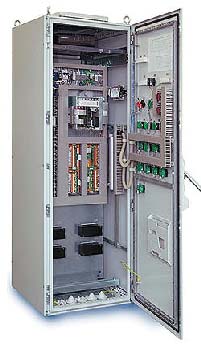
Шкаф - защищенное НКУ, предназначенное для установки на полу
Safety enclosed boards are used for most new installations. Common terms used to designate equipment of this type are metal-enclosed switchgear and metal-clad switchgear.
Most safety enclosed boards are of the unit or sectional type. They consist of a combination of the desired number and type of standardized unit sections.
Each section is a standard factory-assembled combination of a formed steel panel and apparatus mounted on a steel framework.
Safety enclosed switchgear may be classified with respect to purpose of application as follows:
1. General medium- or high-voltage switchgear
2. Primary unit substations
3. Rectifier unit substations
4. Secondary unit substations or power centers
5. General low-voltage switchgear
6. Low-voltage distribution switchboards
7. Motor-control-center switchboards
[American electricians’ handbook]Тематики
- НКУ (шкафы, пульты,...)
Классификация
>>>Обобщающие термины
Синонимы
EN
- enclosed assembly (of switchgear and controlgear)
- enclosed switchboard
- safety enclosed board
- safety enclosed switchgear
DE
FR
Немецко-русский словарь нормативно-технической терминологии > geschlossene (gekapselte) Schaltgerätekombination
-
16 System
система
Группа взаимодействующих объектов, выполняющих общую функциональную задачу. В ее основе лежит некоторый механизм связи.
[ ГОСТ Р МЭК 61850-5-2011]
система
Набор элементов, которые взаимодействуют в соответствии с проектом, в котором элементом системы может быть другая система, называемая подсистемой; система может быть управляющей системой или управляемой системой и включать аппаратные средства, программное обеспечение и взаимодействие с человеком.
Примечания
1 Человек может быть частью системы. Например, человек может получать информацию от программируемого электронного устройства и выполнять действие, связанное с безопасностью, основываясь на этой информации, либо выполнять действие с помощью программируемого электронного устройства.
2 Это определение отличается от приведенного в МЭС 351-01-01.
[ ГОСТ Р МЭК 61508-4-2007]
система
Множество (совокупность) материальных объектов (элементов) любой, в том числе различной физической природы, а также информационных объектов, взаимосвязанных и взаимодействующих между собой для достижения общей цели.
[ ГОСТ Р 43.0.2-2006]
система
Совокупность элементов, объединенная связями между ними и обладающая определенной целостностью.
[ ГОСТ 34.003-90]
система
Совокупность взаимосвязанных и взаимодействующих элементов.
[ ГОСТ Р ИСО 9000-2008]
система
-
[IEV number 151-11-27]
система
Набор связанных элементов, работающих совместно для достижения общей Цели. Например: • Компьютерная система, состоящая из аппаратного обеспечения, программного обеспечения и приложений. • Система управления, состоящая из множества процессов, которые планируются и управляются совместно. Например, система менеджмента качества. • Система управления базами данных или операционная система, состоящая из множества программных модулей, разработанных для выполнения набора связанных функций.
[Словарь терминов ITIL версия 1.0, 29 июля 2011 г.]
система
Множество элементов, находящихся в отношениях и связях друг с другом, которое образует определенную целостность, единство. Следует отметить, что это определение (взятое нами из Большой Советской Энциклопедии) не является ни единственным, ни общепризнанным. Есть десятки определений понятия “С.”, которые с некоторой условностью можно поделить на три группы. Определения, принадлежащие к первой группе, рассматривают С. как комплекс процессов и явлений, а также связей между ними, существующий объективно, независимо от наблюдателя. Его задача состоит в том, чтобы выделить эту С. из окружающей среды, т.е. как минимум определить ее входы и выходы (тогда она рассматривается как “черный ящик”), а как максимум — подвергнуть анализу ее структуру (произвести структуризацию), выяснить механизм функционирования и, исходя из этого, воздействовать на нее в нужном направлении. Здесь С. — объект исследования и управления. Определения второй группы рассматривают С. как инструмент, способ исследования процессов и явлений. Наблюдатель, имея перед собой некоторую цель, конструирует (синтезирует) С. как некоторое абстрактное отображение реальных объектов. При этом С. (“абстрактная система”) понимается как совокупность взаимосвязанных переменных, представляющих те или иные свойства, характеристики объектов, которые рассматриваются в данной С. В этой трактовке понятие С. практически смыкается с понятием модели, и в некоторых работах эти два термина вообще употребляются как взаимозаменяемые. Говоря о синтезе С., в таких случаях имеют в виду формирование макромодели, анализ же С. совпадает в этой трактовке с микромоделированием отдельных элементов и процессов. Третья группа определений представляет собой некий компромисс между двумя первыми. С. здесь — искусственно создаваемый комплекс элементов (например, коллективов людей, технических средств, научных теорий и т.д.), предназначенный для решения сложной организационной, экономической, технической задачи. Следовательно, здесь наблюдатель не только выделяет из среды С. (и ее отдельные части), но и создает, синтезирует ее. С. является реальным объектом и одновременно — абстрактным отображением связей действительности. Именно в этом смысле понимает С. наука системотехника. Между этими группами определений нет непроходимых границ. Во всех случаях термин “С.” включает понятие о целом, состоящем из взаимосвязанных, взаимодействующих, взаимозависимых частей, причем свойства этих частей зависят от С. в целом, свойства С. — от свойств ее частей. Во всех случаях имеется в виду наличие среды, в которой С. существует и функционирует. Для исследуемой С. среда может рассматриваться как надсистема, соответственно, ее части — как подсистемы, а также элементы С., если их внутренняя структура не является предметом рассмотрения. С. делятся на материальные и нематериальные. К первым относятся, например, железная дорога, народное хозяйство, ко вторым — С. уравнений в математике, математика как наука, далее — С. наук. Автоматизированная система управления включает как материальные элементы (ЭВМ, документация, люди), так и нематериальные — математические модели, знания людей. Разделение это тоже неоднозначно: железную дорогу можно рассматривать не только как материальную С., но и как нематериальную С. взаимосвязей, соотношений, потоков информации и т.д. Закономерности функционирования систем изучаются общей теорией систем, оперирующей понятием абстрактной С. Наибольшее значение среди абстрактных С. имеют кибернетические С. Есть два понятия, близкие понятию С.: комплекс, совокупность (множество объектов). Они, однако, не тождественны ему, как нередко утверждают. Их можно рассматривать как усеченные, неполные понятия по отношению к С.: комплекс включает части, не обязательно обладающие системными свойствами (в том смысле, как это указано выше), но эти части сами могут быть системами, и элементы последних такими свойствами по отношению к ним способны обладать. Совокупность же есть множество элементов, не обязательно находящихся в системных отношениях и связях друг с другом. В данном словаре мы стремимся по возможности последовательно различать понятия С. и модели, рассматривая С. как некий объект (реальной действительности или воображаемый — безразлично), который подвергается наблюдению и изучению, а модель — как средство этого наблюдения и изучения. Разумеется, и модель, если она сама оказывается объектом наблюдения и изучения, в свою очередь рассматривается как С. (в частности, как моделируемая С.) — и так до бесконечности. Все это означает, что такие, например, понятия, как переменная или параметр, мы (в отличие от многих авторов) относим не к С., а к ее описанию, т.е. к модели (см. Параметры модели, Переменная модели), численные же их значения, характеризующие С., — к С. (например, координаты С.). • Системы математически описываются различными способами. Каждая переменная модели, выражающая определенную характеристику С., может быть задана множеством конкретных значений, которые эта переменная может принимать. Состояние С. описывается вектором (или кортежем, если учитываются также величины, не имеющие численных значений), каждая компонента которого соответствует конкретному значению определенной переменной. С. в целом может быть описана соответственно множеством ее состояний. Например, если x = (1, 2, … m) — вектор существенных переменных модели, каждая из которых может принять y значений (y = 1, 2, …, n), то матрица S = [ Sxy ] размерностью m ? n представляет собой описание данной С. Широко применяется описание динамической С. с помощью понятий, связанных с ее функционированием в среде. При этом С. определяется как три множества: входов X, выходов Y и отношений между ними R. Полученный “портрет системы” может записываться так: XRY или Y = ®X. Аналитическое описание С. представляет собой систему уравнений, характеризующих преобразования, выполняемые ее элементами и С. в целом в процессе ее функционирования: в непрерывном случае применяется аппарат дифференциальных уравнений, в дискретном — аппарат разностных уравнений. Графическое описание С. чаще всего состоит в построении графа, вершины которого соответствуют элементам С., а дуги — их связям. Существует ряд классификаций систем. Наиболее известны три: 1) Ст. Бир делит все С. (в природе и обществе), с одной стороны, на простые, сложные и очень сложные, с другой — на детерминированные и вероятностные; 2) Н.Винер исходит из особенностей поведения С. (бихевиористский подход) и строит дихотомическую схему: С., характеризующиеся пассивным и активным поведением; среди последних — нецеленаправленным (случайным) и целенаправленным; в свою очередь последние подразделяются на С. без обратной связи и с обратной связью и т.д.; 3) К.Боулдинг выделяет восемь уровней иерархии С., начиная с простых статических (например, карта земли) и простых кибернетических (механизм часов), продолжая разного уровня сложности кибернетическими С., вплоть до самых сложных — социальных организаций. Предложены также классификации по другим основаниям, в том числе более частные, например, ряд классификаций С. управления. См. также: Абстрактная система, Адаптирующиеся, адаптивные системы, Большая система, Вероятностная система, Выделение системы, Входы и выходы системы, Детерминированная система, Динамическая система, Дискретная система, Диффузная система, Замкнутая (закрытая) система, Иерархическая структура, Имитационная система, Информационная система, Информационно-развивающаяся система, Кибернетическая система, Координаты системы, Надсистема, Нелинейная система, Непрерывная система, Открытая система, Относительно обособленная система, Память системы, Подсистема, Портрет системы, Разомкнутая система, Рефлексная система, Решающая система, Самонастраивающаяся система, Самообучающаяся система, Самоорганизующаяся система, Сложная система, Состояние системы, Статическая система, Стохастическая система, Структура системы, Структуризация системы, Управляющая система, Устойчивость системы, Целенаправленная система, Экономическая система, Функционирование экономической системы..
[ http://slovar-lopatnikov.ru/]EN
system
set of interrelated elements considered in a defined context as a whole and separated from their environment
NOTE 1 – A system is generally defined with the view of achieving a given objective, e.g. by performing a definite function.
NOTE 2 – Elements of a system may be natural or man-made material objects, as well as modes of thinking and the results thereof (e.g. forms of organisation, mathematical methods, programming languages).
NOTE 3 – The system is considered to be separated from the environment and the other external systems by an imaginary surface, which cuts the links between them and the system.
NOTE 4 – The term "system" should be qualified when it is not clear from the context to what it refers, e.g. control system, colorimetric system, system of units, transmission system.
Source: 351-01-01 MOD
[IEV number 151-11-27]
system
A number of related things that work together to achieve an overall objective. For example: • A computer system including hardware, software and applications • A management system, including the framework of policy, processes, functions, standards, guidelines and tools that are planned and managed together – for example, a quality management system • A database management system or operating system that includes many software modules which are designed to perform a set of related functions.
[Словарь терминов ITIL версия 1.0, 29 июля 2011 г.]FR
système, m
ensemble d'éléments reliés entre eux, considéré comme un tout dans un contexte défini et séparé de son environnement
NOTE 1 – Un système est en général défini en vue d'atteindre un objectif déterminé, par exemple en réalisant une certaine fonction.
NOTE 2 – Les éléments d'un système peuvent être aussi bien des objets matériels, naturels ou artificiels, que des modes de pensée et les résultats de ceux-ci (par exemple des formes d'organisation, des méthodes mathématiques, des langages de programmation).
NOTE 3 – Le système est considéré comme séparé de l'environnement et des autres systèmes extérieurs par une surface imaginaire qui coupe les liaisons entre eux et le système.
NOTE 4 – Il convient de qualifier le terme "système" lorsque le concept ne résulte pas clairement du contexte, par exemple système de commande, système colorimétrique, système d'unités, système de transmission.
Source: 351-01-01 MOD
[IEV number 151-11-27]Тематики
- автоматизированные системы
- информационные технологии в целом
- релейная защита
- системы менеджмента качества
- экономика
EN
DE
FR
Немецко-русский словарь нормативно-технической терминологии > System
-
17 äußer
I Präp. (+ Dat)1. (Ggs. in) out of; außer Reichweite out of ( oder beyond) reach; außer Sichtweite / Atem / Gefahr / Betrieb / Frage etc. out of sight / breath / danger / order / the question etc.; außer Haus sein / essen be / eat out; Land2. außer sich sein be beside o.s. ( vor with); außer sich geraten lose control over o.s.; umg. flip one’s lid, go mad3. (abgesehen von) apart from, bes. Am. aside from; except (for); alle / niemand außer mir all / no-one except ( oder but) me; außer ihr kenne ich keine Künstler I don’t know any artists other than ( oder apart from) her; täglich außer montags every day except (for) Mondays; sie geht nicht gern aus, außer zum Tanzen she doesn’t like to go out much, apart from dancing4. (zusätzlich zu) besides, in addition to; außer Spanisch spricht sie auch noch Russisch und Polnisch as well as Spanish she also speaks Russian and Polish; außer Pamela und Pia kommt auch noch Eva as well as Pamela and Pia, Eva’s coming tooII Konj.: außer ( wenn) unless; außer dass except that, apart from the fact that; seine Theorie versteht niemand außer er selbst no one can understand his theory except him, he is the only one who understands his theory* * *aside from (Präp.); save (Präp.); short of (Präp.); beyond (Präp.); apart from (Präp.); except for (Präp.); besides (Präp.); but (Konj.); excepting (Präp.); except (Präp.); out of (Präp.); outside of (Präp.)* * *au|ßer ['ausɐ]1. prep +dat or (rare) gen1) (räumlich) out ofáúßer Haus or Hauses sein/essen — to be/eat out
áúßer Atem — out of breath
See:→ Achtáúßer ihm habe ich keine Verwandten mehr — I have no relatives left apart from him or left but him
3) (= zusätzlich zu) in addition to2. conjexceptáúßer dass... — except that...
áúßer wenn... — except when...
áúßer sonntags — except Sundays
* * *1) (in addition to: Is anyone coming besides John?) besides2) (except: All bar one of the family had measles.) bar3) (except (for): no-one but me; the next road but one.) but4) (leaving out; not including: They're all here except him; Your essay was good except that it was too long.) except5) (excluding: That is the price of the meal exclusive of service charge.) exclusive of6) (except: There was no-one there other than an old woman.) other than7) (having none left: She is quite out of breath.) out of8) (except: All save him had gone; We have no news save that the ship reached port safely.) save* * *au·ßer[ˈausɐ]1. (abgesehen von) apart from, except for\außer dir waren alle auf dem Fest everyone was at the party but [or apart from] you2. (zusätzlich zu) in addition to, apart from\außer ihrer eigenen Arbeit musste sie noch die seinige erledigen she had to do his work as well as her own3. (nicht in) out of\außer Betrieb/Sicht/Gefahr sein to be out of order/sight/danger4.II. konj▪ \außer dass except that▪ \außer [wenn] except [when]* * *1.1) auch mit Gen. (außerhalb) out of2) (abgesehen von) apart fromalle außer mir — all except [for] me
3) (zusätzlich zu) in addition to2.etwas außer jeden Zweifel stellen — make something very clear or clear beyond all doubt
3.außer sich geraten — become beside oneself (vor + Dat. with)
Konjunktion s. ausgenommen4.Adverb except* * *äußer… adj; nur attr1. Mauer, Schicht etc: outer, outside; Verletzung, Angelegenheit, Umstände, Ursache: external; Druck: outside, external, from outside; Gefahr: external, from outside; Ähnlichkeit, Eindruck: (on the) surface, outward;äußerer Rahmen setting (+gen for);2. WIRTSCH, POL foreign* * *1.1) auch mit Gen. (außerhalb) out ofaußer sich sein — be beside oneself (vor + Dat. with)
2) (abgesehen von) apart fromalle außer mir — all except [for] me
3) (zusätzlich zu) in addition to2.etwas außer jeden Zweifel stellen — make something very clear or clear beyond all doubt
3. 4.außer sich geraten — become beside oneself (vor + Dat. with)
Adverb except* * *adj.outside adj. adv.except (for) adv.except adv.save adv. präp.beside prep.besides prep. -
18 Welle
f; -, -n1. auf Wasseroberfläche: wave; kleine: ripple; die See hat heute hohe Wellen there are big waves on the sea today; die Wellen schlagen ans Ufer the waves beat against the shore; Wellen schlagen fig., Ereignis etc.: make waves, cause a stir; die Stimmung schlug hohe Wellen spirits were high4. TECH. shaft5. Turnen: circle6. fig. (Mode etc.) craze7. MOT.: grüne oder rote Welle phased ( oder linked) traffic lights; wir haben grüne / rote Welle we’ve caught the green / red phase* * *die Welle(Funk) wave; wavelength;(Mechanik) axle; shaft;(Mode) craze;(Physik) wave;(Wasser) wave; billow* * *Wẹl|le ['vɛlə]f -, -nweiche Welle (inf) — soft line
2) (fig = Mode) crazedie Neue Welle (Film) — the nouvelle vague, the New Wave; (Mus) the New Wave
* * *die1) (a thin pin on which something turns: I can't turn on the radio any more, because the spindle of the control knob has broken.) spindle2) (a revolving bar transmitting motion in an engine: the driving-shaft.) shaft3) (a surging movement, or a sudden rush: The stone hit his head and he felt a surge of pain; a sudden surge of anger.) surge4) (a moving ridge, larger than a ripple, moving on the surface of water: rolling waves; a boat tossing on the waves.) wave5) (a vibration travelling eg through the air: radio waves; sound waves; light waves.) wave6) (a curve or curves in the hair: Are those waves natural?) wave7) (a (usually temporary) rise or increase: the recent crime wave; a wave of violence; The pain came in waves.) wave* * *Wel·le<-, -n>[ˈvɛlə]f1. (Woge) wave2. (massenhaftes Auftreten) wavedie neue \Welle the latest craze3. PHYS wave4. RADIO wavelength5. (wellenförmige Erhebung) wave7.▶ [hohe] \Wellen schlagen to create a [big] stir* * *die; Welle, Wellen1) (auch HaarWelle, Physik, fig.) wavegrüne Welle — (Verkehrsw.) linked or synchronised traffic lights
die weiche Welle — (fig. ugs.) the soft approach or line
2) (Rundf.): (Wellenlänge) wavelength3) (Technik) shaft4) (BodenWelle) undulation* * *die See hat heute hohe Wellen there are big waves on the sea today;die Wellen schlagen ans Ufer the waves beat against the shore;die Stimmung schlug hohe Wellen spirits were high4. TECH shaft5. Turnen: circle6. fig (Mode etc) craze7. AUTO:rote Welle phased ( oder linked) traffic lights;wir haben grüne/rote Welle we’ve caught the green/red phase* * *die; Welle, Wellen1) (auch HaarWelle, Physik, fig.) wavegrüne Welle — (Verkehrsw.) linked or synchronised traffic lights
die weiche Welle — (fig. ugs.) the soft approach or line
2) (Rundf.): (Wellenlänge) wavelength3) (Technik) shaft4) (BodenWelle) undulation* * *-n f.arbor n.axle n.billow n.shaft n.wave n. -
19 welle
f; -, -n1. auf Wasseroberfläche: wave; kleine: ripple; die See hat heute hohe Wellen there are big waves on the sea today; die Wellen schlagen ans Ufer the waves beat against the shore; Wellen schlagen fig., Ereignis etc.: make waves, cause a stir; die Stimmung schlug hohe Wellen spirits were high4. TECH. shaft5. Turnen: circle6. fig. (Mode etc.) craze7. MOT.: grüne oder rote Welle phased ( oder linked) traffic lights; wir haben grüne / rote Welle we’ve caught the green / red phase* * *die Welle(Funk) wave; wavelength;(Mechanik) axle; shaft;(Mode) craze;(Physik) wave;(Wasser) wave; billow* * *Wẹl|le ['vɛlə]f -, -nweiche Welle (inf) — soft line
2) (fig = Mode) crazedie Neue Welle (Film) — the nouvelle vague, the New Wave; (Mus) the New Wave
* * *die1) (a thin pin on which something turns: I can't turn on the radio any more, because the spindle of the control knob has broken.) spindle2) (a revolving bar transmitting motion in an engine: the driving-shaft.) shaft3) (a surging movement, or a sudden rush: The stone hit his head and he felt a surge of pain; a sudden surge of anger.) surge4) (a moving ridge, larger than a ripple, moving on the surface of water: rolling waves; a boat tossing on the waves.) wave5) (a vibration travelling eg through the air: radio waves; sound waves; light waves.) wave6) (a curve or curves in the hair: Are those waves natural?) wave7) (a (usually temporary) rise or increase: the recent crime wave; a wave of violence; The pain came in waves.) wave* * *Wel·le<-, -n>[ˈvɛlə]f1. (Woge) wave2. (massenhaftes Auftreten) wavedie neue \Welle the latest craze3. PHYS wave4. RADIO wavelength5. (wellenförmige Erhebung) wave7.▶ [hohe] \Wellen schlagen to create a [big] stir* * *die; Welle, Wellen1) (auch HaarWelle, Physik, fig.) wavegrüne Welle — (Verkehrsw.) linked or synchronised traffic lights
die weiche Welle — (fig. ugs.) the soft approach or line
2) (Rundf.): (Wellenlänge) wavelength3) (Technik) shaft4) (BodenWelle) undulation* * *…welle f im subst1. (Bewegung):Auswanderungswelle wave of emigration;Asylantenwelle wave of asylum-seekers2. (Mode):Fitnesswelle fitness craze;Fresswelle (eating) binge* * *die; Welle, Wellen1) (auch HaarWelle, Physik, fig.) wavegrüne Welle — (Verkehrsw.) linked or synchronised traffic lights
die weiche Welle — (fig. ugs.) the soft approach or line
2) (Rundf.): (Wellenlänge) wavelength3) (Technik) shaft4) (BodenWelle) undulation* * *-n f.arbor n.axle n.billow n.shaft n.wave n. -
20 Leit- und Kontrollsystem für den Rollfeldverkehr
n:V < aerospace> (wg. Kollisionsrisiko; als System) ■ surface movement guidance and control system (SMGCS)German-english technical dictionary > Leit- und Kontrollsystem für den Rollfeldverkehr
- 1
- 2
См. также в других словарях:
Control surface — may refer to: Audio control surface a control surface in airplane flight controls Diving plane, a control surface in submarines In fluid dynamics, a surface through which flux occurs, causing convergence or divergence of a control volume (see… … Wikipedia
control surface — noun a device that provides reactive force when in motion relative to the surrounding air; can lift or control a plane in flight • Syn: ↑airfoil, ↑aerofoil, ↑surface • Hypernyms: ↑device • Hyponyms: ↑aileron, ↑ … Useful english dictionary
control surface — control′ sur face n. aer. any movable airfoil, as a rudder, flap, or aileron, for guiding or controlling an aircraft or missile in flight … From formal English to slang
control surface — noun A moveable surface attached to a machine such as an aircraft or submarine that can be used to control the machines motion in roll, pitch or yaw. Before flight its is vital to ensure all control surfaces are clear of obstruction and can move… … Wiktionary
control surface — Aerodynamic surfaces operated from the cockpit controls to control the trajectory of an aircraft. The three primary controls are ailerons, elevators, and rudders. Flaps are secondary control surfaces … Aviation dictionary
control surface — noun Date: 1917 a movable airfoil designed to change the attitude of an aircraft … New Collegiate Dictionary
control surface — any movable airfoil, as a rudder, flap, or aileron, for guiding or controlling an aircraft or missile in flight. [1915 20] * * * … Universalium
control surface — /kənˈtroʊl sɜfəs/ (say kuhn trohl serfuhs) noun any of various hinged, movable airfoils at the rear of the fixed airfoils, forming the primary controls of an aircraft …
Audio control surface — In the domain of digital audio, a control surface is a human interface device (HID) which allows the user to control a digital audio workstation or other digital audio application. Generally, a control surface will contain one or more controls… … Wikipedia
balanced control surface — i. A control surface that is aerodynamically balanced to reduce the force necessary to displace it by providing some area ahead of the hinge line. ii. A control surface balanced by weights ahead of its hinge line to reduce possible flutter … Aviation dictionary
Control volume — Thermodynamics … Wikipedia
